Positions Through Contextualising
24-04-23 to 19-05-23
Studio Work
Bibliography
Adhocism (Jencks and Silver, 1972 [2013]) states “Nothing is created from nothing.” which has been a key quote for me in this project, the entire process began in Unit 1 with an ad-hoc decision to use existing discarded prints as a basis for a Riso project because I needed a way to make interesting explorations without using too many masters. This then grew into new areas, by taking that topic and combining it with new ideas like AI, gibberish, appropriation, and internet culture.
Another theme found in Adhocism is that things are most radical when they are first invented, and gradually plateau into general conformity. The book was written in 1972, but is very applicable to modern online life: I’ve witnessed digital user interfaces, smartphones, and to some extent laptops evolve like this in my lifetime, which is one reason why internet history is such a fascinating topic to me.
“We search to find meanings where none is intended, simply because the usual meanings are avoided and the mind is led beyond the cliche.” I started to do this in Unit 1, by elevating discarded prints and highlighting pieces of text that weren’t originally printed alongside one another. But I explored it more throughout Unit 2, by taking ‘internet detritus’ like pop-up ads, low-quality photos, dated styles and heightening them in a printed publication.
---
Users, advertisers – we are all trapped in the ‘enshittification’ of the internet (Naughton, 2023) is an article explaining the idea of ‘enshittification’ as websites are built to attract as many users as possible, then they abuse the regular users to benefit business users, then they abuse those business consumers to scrape the last benefits for themselves; which is something I’ve noticed gradually happening more and more, and could help form the basis of an exploration into the way internet culture and aesthetics have changed over time.
“The business model of targeted advertising that underpins the grotesque deformations of online platforms could be outlawed, but that, too, seems unlikely in a neoliberal world.” is an interesting perspective, which could perhaps be an inspiration to focus on the impact capitalism/neoliberalism has had on the way the internet has been shaped, going from radical freedom and anarchy to consolidation of power in the hands of a few mega-corporations. I would also be interested in investigating the nostalgia for a past version of the internet, as unlike old books, films, or music it's almost impossible to go back to the experience of using the internet of the past.
---
Project Seen (Kozole, 2015) explores how removing context and obscuring elements can help create a compelling, critical look at the original item, which is something I have tried to do in my projects since Methods of Iterating. I don't think I've been as successful as Emil was, as his direct focus on one topic created a really strong link between theory and output. I do, however, feel that my work is heading in the right direction and hopefully over the upcoming projects I'll be able to refine my criticality and link it closer to projects. Project Seen also explores online surveillance and the way we are monitored in many aspects of our online lives, which has obvious parallels to the fact that my selected reference is a massive dataset of images scraped from the internet, many of which were not created to be viewed by the general public.
---
In some respects, Parallel Encyclopedia (Suter, 2007) is similar to Project Seen, but instead of focusing on text its primary concern is images and instead of obscuring things it’s about surrounding them with different contexts to change their perception. I think Parallel Encyclopedia is particularly related to my exploration in week 1, where I made a chain from images that seemed completely unrelated, but have some kind of connection between them, and it's something I tried to continue with in week 3. By arranging the images in a new context, divorced from their original intention and combined with new accompanying pictures I tried to engage the reader and make them look more deeply and critically at disposable, unwanted relics of a past internet age.
---
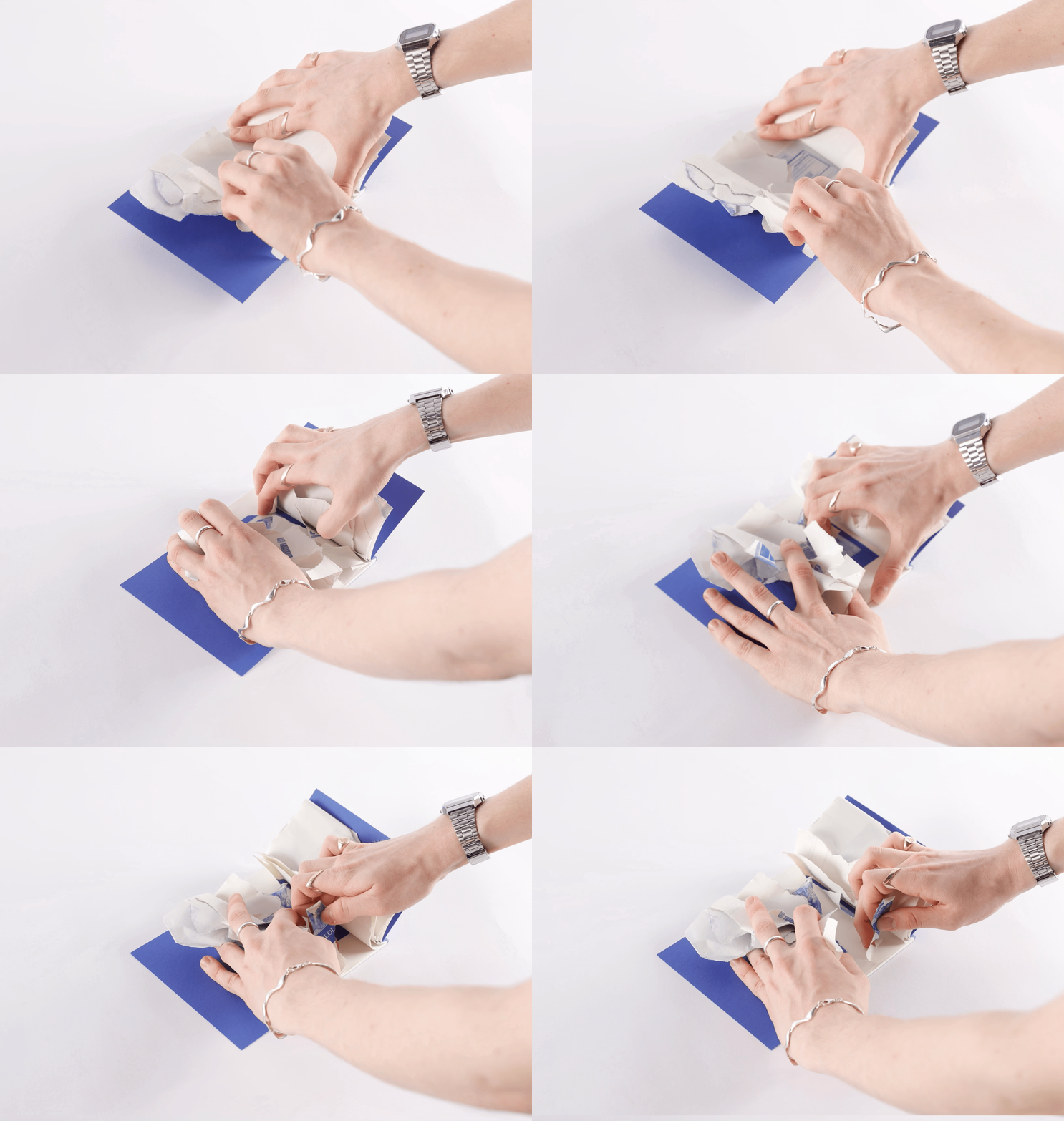
In Post-Digital Print (Ludovico, 2012), Alessandro Ludovico argues that the rise of digital technologies has not led (and will not lead) to the disappearance of printing, but instead that it has forced a transformation in the role and application of print. The idea of print being "more than just a carrier for things to be shown on some display; it is also the display itself." was a big inspiration behind my decision to experiment with the form of print and publication itself, as this made me look at the form of printed media more deeply. Ludovico also says that changing the form of print goes deeper than other similar media that transformed (such as photography, video, and music) and so changing the form of a printed object "consequently changes people’s experience, with all the (physical) habits, rituals and cultural conventions involved." He later goes on to say "Traditional print publishing, on the other hand, is increasingly presenting its products as valuable objects and collector’s items", which I agree with, and I thought it would be interesting to explore how people value objects just because they are printed; which I think was evidenced in the final Positions Through Contextualising seminar, where everyone was reluctant to tear my work apart even though that was how it had to be read.
Critical Analysis
LAION-400M (LAION, 2021) is a collection of 400 million images downloaded and archived from various public internet sources by a non-profit called Common Crawl, which has been captioned by OpenAI's CLIP AI.
I initially encountered it when researching biases in AI, (within Multimodal datasets: misogyny, pornography, and malignant stereotypes (Birhane, Uday Prabhu, & Kahembwe, 2021)) and how they are reinforced by the systems of creation, but I became particularly interested when reading the kind of gibberish captions found, and it felt like a full circle moment, linking gibberish and AI from ‘behind the curtain’ after I had already explored it with my first publication.
The images collected in the set have already been taken out of context, with things like web headers and parts of an incomplete image, so I think taking them even further out of context and into a whole new medium could allow us to look at them in a new light. Instead of simply discarding an ugly untrendy logo it’s interesting to consider its merits. I feel that when you put something into a publication it implies an inherent value, whereas most of the images in the set are ‘worthless’, dated, and out of most people’s view; so I'd like to look at early 2000s internet culture. I think this was a pivotal point for the internet as this is when it entered the average home, and it's also the time for which I have the strongest nostalgia.
An interesting aspect of LAION-400M is the way it is distributed and accessed, which is in several forms. The entire set can be downloaded, but it's 10TB, meaning it's very difficult for most people to store locally. There's also a 50GB text-based file indexing all the captions with URL links, but the most easy to access is through an online catalogue called Clip retrieval, and this is the way I accessed the content. Because the set itself has no one set way of accessing it, there is not an expected way to view and digest the set—in fact most people who've seen the set will only see a tiny fraction of the images, and most of it is designed for computers to process.
Another intriguing thing with the dataset is that it is used to train AI models and when browsing through you can find clear biases that are being accelerated and implemented into user-facing AI software. For example, if you search CEO into LAION-400M most of the results tend to be white men, which then means that if you ask DALL-E to make you an image of a CEO it will likely present to you an image of a white man (Birhane, Uday Prabhu, & Kahembwe, 2021), which perpetuates harmful assumptions.
The way queries are presented within is also interesting, as instead of like Google or Bing—which prioritise showing what they think the user wants to see—the online catalogue seems to order images at random, and it’s hard to tell why some images are near the top. This can create interesting search results, making us consider how much of our online life, even something as simple as an image search, is highly curated.
---
The Gleaners and I (Varda, 2000) continued to be a source of inspiration even after it helped me to recenter my project in Iterating.
I found The Gleaners and I to be fascinating in the context of graphic communication. The film shows the power of visual storytelling and the potential of design to challenge societal narratives. I also think Varda made several brilliant decisions when it came to the presentation of the film. Throughout the film, Varda subverts the process and aesthetics of home video making. The film goes between choreographed, meticulously framed shots and shaky footage that help to engage the viewer and bring a deeper connection to the film and the topic at hand. I also think that using a camcorder disarmed subjects, who may have become more open and honest than if it was with a more typical filming set-up. I think this idea could also be applied to more traditional forms of graphic communication, like a publication or zine, by creating an output that disarms a subject or viewer and then subverting their expectations; similar to what I was trying to do with my final Positions Through Translating project.
The Gleaners and I is not simply shaped by the medium of film, but it is intertwined with a specific time in the history of video creation. The use of a handheld camcorder, which did not rely on film, allowed Varda to shoot hours of footage with more freedom than she was typically used to. Varda was able to capture spontaneous moments and convey a sense of immediacy, highlighting the vulnerability and resilience of the gleaners. And the use of a camcorder also gave way to some of the most thoughtful and fun insights in the documentary; one that particularly stands out to me is when Varda uses her hand to frame trucks passing on the motorway. This is reminiscent of games played as a child on long road trips, and to me represents Varda feeling free and full of childlike wonder, which allowed her to create such an nonjudgemental portrait of the gleaners.
The choice of a democratised method of filming helps link to the key themes found throughout the film, as Varda questions why society rejects the act of gleaning, highlighting the wastefulness of contemporary consumer culture. Through her interviews with various gleaners, she portrays them not as social outcasts but as resourceful individuals who find sustenance and meaning in their work. Varda's rhetorical approach challenges viewers to consider their preconceived notions of poverty, labour, and the value of discarded objects.
Jencks, C. and Silver, N. (1972 [2013]) Adhocism: The Case for Improvisation. Cambridge: The MIT Press.
Naughton, J.(2023) Users, advertisers – we are all trapped in the enshittification of the internet | The Guardian. Available at: https://www.theguardian.com/commentisfree/2023/mar/11/users-advertisers-we-are-all-trapped-in-the-enshittification-of-the-internet (Accessed: 15 May 2023).
Kozole, E. (2015) Project Seen.
Suter, B. (2007) Parallel encyclopedia. Amsterdam: Roma Publications.
Ludovico, A. (2012) Post-Digital Print: The Mutation of Publishing since 1894. Eindhoven: Onomatopee.
LAION (2021) LAION-400 Million Dataset.
Birhane, A., Uday Prabhu, V. and Kahembwe, E. (2021) Multimodal datasets: misogyny, pornography, and malignant stereotypes. arXiv preprint arXiv:2110.01963.
Varda, A. (2000) The Gleaners and I. Paris: Ciné Tamaris.